A Late-Autumn Walk Through a Woodland Edge
A late-autumn woodland edge walk helps you read changing light and fallen leaves as clues to where trees meet open ground and how that boundary shifts.
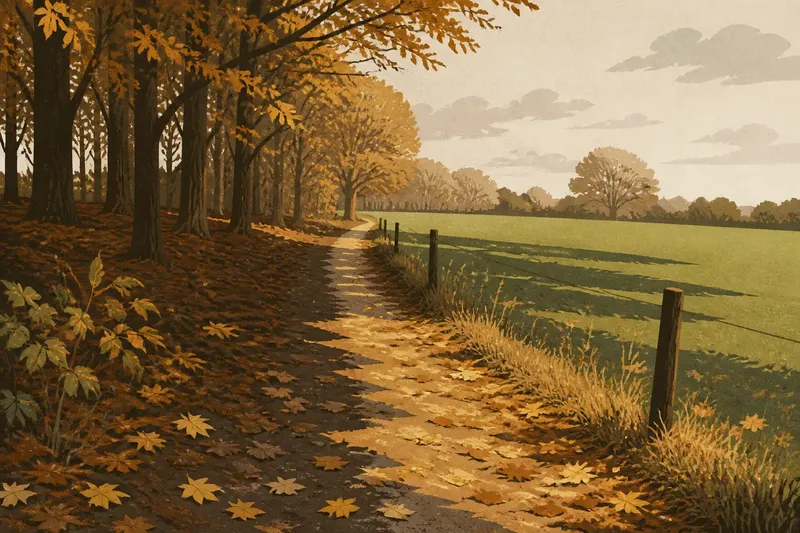
The most common mistake on a late-autumn woodland edge walk is to treat the tree line as a backdrop and keep moving; that costs you the clearest clues about how woodland meets open ground. A woodland edge is the changing boundary where tree cover gives way to a field, track, or other open space, and fallen leaves and shifting light make its shape easier to notice.
Choose the kind of walk that fits the conditions underfoot and the time you have. The aim is not to identify every plant, but to see how the edge changes across a short stretch, then let the leaves and light guide your attention.
Choose your walking conditions
If the ground is wet or slick, choose a broad, established path with firm footing and a clear view toward the trees. Wet leaves can hide uneven ground, so keep your attention on the path rather than stepping off it to inspect a patch of color.
If the day is bright with low sun, pick a route that lets you look along the edge rather than directly into glare. The angle of light can reveal differences between the shaded woodland floor and the open side, while a view from the side makes the boundary easier to trace.
If cloud cover is even, use a stretch with varied tree cover and open gaps. Softer light can make leaf colors easier to compare, and the change from dense canopy to a clearing may stand out more than it does under sharp shadows.
If your time is short, walk one small section and pause at a place where the trees thin. A focused view of one transition is more useful than hurrying along a longer route without time to look.
Where access, path conditions, or local rules are uncertain, follow posted signs and the land manager’s guidance.
Read light across the edge
Begin by noticing where the shade ends, not by naming the trees. Look for the line where bright ground becomes mottled, then check whether that line follows a straight boundary or bends around a group of trees, a hollow, or a jutting corner of woodland.
Light changes the apparent width of an edge. In low sun, long shadows can reach well into an open field and make the woodland seem to extend farther than its trunks do; under a clouded sky, the same edge may look flatter and less distinct. Compare the shadow with the visible trunks so you do not mistake a shadow line for the woodland boundary itself.
Look upward as well as outward. A gap in the canopy can admit a bright patch onto the ground, while interlaced branches may keep a strip dim even where the trees are sparse. These contrasts tell you where the canopy is open or layered, without requiring you to identify each branch.
On a sunny stretch, pause where the shadow crosses the path and look back toward the tree line. The reverse view often shows the edge’s irregular shape more clearly.
Follow the fallen leaves
Leaves can reveal how wind and ground shape the edge, but their color alone does not tell the whole story. Notice where they gather: against a fence, in a shallow dip, beneath a dense canopy, or along the side of a path. A drift may reflect a low obstacle or a gust channel as much as the position of the nearest tree.
Compare the open side with the wooded side. Leaves on exposed ground may be scattered or pressed flat, while those under branches can form a thicker covering. If the ground slopes, look for leaves collected at its lower edge; gravity can shift them downhill, making the accumulation look like a boundary when it is really a small change in terrain.
Color offers a prompt for close observation, not a reliable label for a tree. Several kinds of leaves can overlap on the ground, and dampness or shade can alter their appearance. Instead, compare shape, size, and where the leaves lie, then look overhead for a matching branch if one is easy to see from the path.
Imagine you reach a field corner where pale leaves collect in a narrow band. You pause, see that the band follows a slight dip rather than the line of trunks, and look uphill for the source of the drift; the expected result is a clearer distinction between a ground-shaped leaf deposit and the woodland edge itself.
Choose what to observe next?
How do I tell where woodland ends?
Use the trunks and canopy together: the edge is the transition in tree cover, not necessarily the last shadow or the line of scattered leaves. A few isolated trees beyond the main stand may soften the boundary rather than move it to a precise line.
Why do leaves collect in one place?
Wind, slope, low barriers, and damp ground can all influence where leaves settle. Compare the deposit with nearby dips, fences, and exposed gaps before treating it as a marker of tree cover.
What should I notice on a cloudy day?
Look for changes in canopy density and the contrast between leaf-covered ground and open soil. Without strong shadows, small gaps and overlapping branches may become easier to compare across the edge.
Can I identify trees from fallen leaves?
Sometimes a leaf’s outline can suggest a tree group, but fallen leaves may be mixed or weather-worn. Treat identification as tentative and compare a leaf with branches still attached when they are visible from a safe path.
Fit the walk to the light
If you want to understand the edge’s shape, walk beside it and look across the boundary at several points. If you want to notice how light travels over the ground, choose a time when shadows are visible and compare their reach with the trunks. If leaves are your main prompt, focus on where they accumulate and what nearby features may have directed them.
These aims can overlap, but one should lead. A walk centered on leaf drift needs time to look down and compare nearby ground; a walk centered on light calls for repeated glances between canopy, shadow, and open space. Choosing one emphasis keeps each pause useful.
At the end of the path, turn around and look back along the boundary. The return view may make a bend, gap, or change in canopy stand out that was hidden by your direction of travel.
Leave the edge undisturbed
Keep to the path where one is provided, and observe leaves, branches, and tracks in place rather than rearranging them. A light touch preserves the scene for the next walker and avoids disturbing small animals sheltering in leaf litter.
For a late-autumn woodland edge walk, the most useful observation may be modest: a shadow extending beyond the trunks, a leaf drift shaped by a shallow hollow, or a canopy gap brightening one patch of ground. Before leaving, note which feature made the boundary easiest to read; that single detail can help you recognize how woodland and open ground meet on another walk.