Why a Valley Can Hold a Different Kind of Weather
Learn how valley shape affects wind, shade, and cool air so you can read local weather changes more carefully on a country walk.
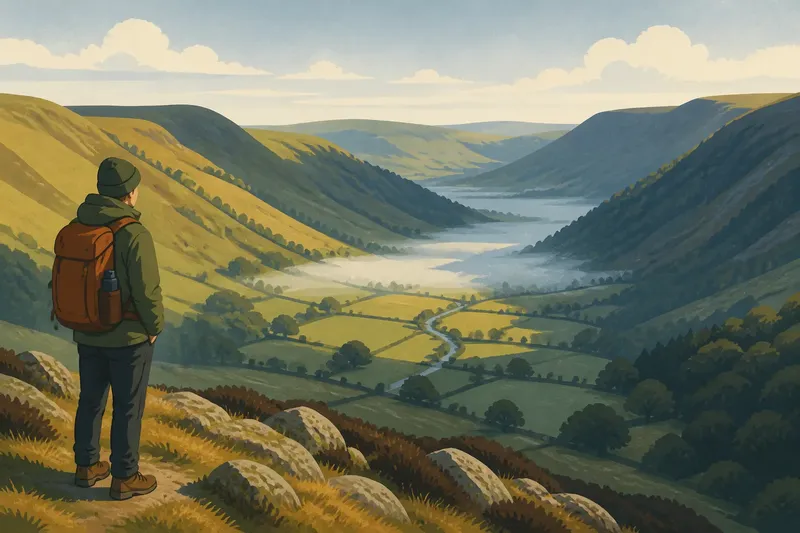
The common mistake in reading valley weather is to assume that the temperature and wind on the road apply equally to the slope and valley floor. That can leave you unprepared for a chilly hollow, a wind-bent ridge, or a shaded path that stays damp after nearby ground has dried. Valley shape offers useful clues, but it does not dictate a single kind of weather.
To understand those clues, look in sequence: note the landform, identify where sun and wind can reach, watch for cool air settling, then compare what you observe with the wider conditions. This is not a forecast method. It is a way to make sense of the small differences that can occur within one landscape.
Read the valley shape
Begin from a safe, open viewpoint and trace the valley’s outline. A broad, shallow valley leaves more room for air to move across its floor, while a narrow valley with steep sides can shelter some places from crosswinds. The shape also affects how much sky is visible from the bottom.
Notice whether the valley runs straight, bends, or opens into a larger basin. A bend may put one slope in the lee of another, reducing direct exposure to a particular wind. An enclosed basin can limit the easy escape of cool air, though gaps and lower outlets may let it drain away.
Look at the slope angles and the height of the surrounding ground. A low shoulder may block a breeze from one direction; a high, exposed ridge may receive wind that barely reaches the floor. These relationships are directional, so a place sheltered from a west wind may be open to one arriving from another quarter.
Keep the larger terrain in view, too. A valley is part of a connected landscape, not a sealed container. An opening, neighboring ridge, or change in elevation can channel airflow into or out of it.
Trace sun and shade
Next, consider which slopes face the sun during the part of the day you are observing. In the Northern Hemisphere, south-facing slopes generally receive more direct sunlight than north-facing slopes, although the valley’s orientation, cloud cover, season, and nearby terrain all alter the pattern. The reverse broad tendency applies in the Southern Hemisphere.
Shade is not simply a matter of compass direction. A steep slope can cast a long shadow across the floor, and a high ridge may block low-angle sunlight in the morning or late afternoon. Trees and buildings can add smaller patches of shade, so distinguish their effects from the broad shadow cast by the landform.
Sunlight warms the ground, which then influences the air close to it. A sunlit slope may feel warmer than a shaded one nearby, while the shaded slope can retain dampness or coolness. That contrast is most useful as a local observation, not as a promise that one side will always be warmer.
If clouds move across the sky, the contrast can change quickly. Compare the same two places again after the light shifts, rather than treating a single moment as the valley’s usual pattern.
Follow wind exposure
Now identify the wind direction using a weather forecast or a simple observation, such as watching grass, leaves, or a ribbon. Look for the route that wind could take through the valley. A straight, open corridor may guide airflow along its length; a bend or narrowing can redirect it, and a ridge can expose one side while sheltering another.
Wind is not always strongest where the land looks most enclosed. Air can accelerate through a gap, spill over a ridge, or be deflected down a slope. At the same time, a sheltered pocket behind a bank or rise may feel calm even when a nearby crest is breezy.
Use visible signs as clues rather than measurements. Grass leaning in a consistent direction, leaves moving at the ridge, or a sheltered patch with still branches can help you compare exposure. One gust or a momentary lull is not enough to establish a pattern.
Imagine you are walking from an open ridge into a narrow valley with a bend. If the forecast wind comes across the ridge, the crest may feel exposed, while the bend’s inner side may feel calmer; a gap farther along could then funnel the breeze toward the floor. The useful result is a more specific expectation about where conditions may change, not a certainty about what you will feel.
Watch cool air settle
On clear, calm evenings and overnight, the ground loses heat. Air near a slope can cool, become denser, and flow downhill under gravity. This movement is often called cold-air drainage; the name describes the air’s relative coolness, not a separate kind of weather system.
Cool air may collect at a low point, especially where a valley floor is enclosed or its outlet is restricted. A stream hollow, basin, or low field can therefore feel cooler than a nearby slope. The same process can be weaker or absent when wind mixes the air, cloud cover limits cooling, or the terrain allows air to drain freely.
Look for a change in elevation rather than assuming that every valley bottom behaves alike. A floor that slopes gently toward an open outlet may release cool air, while a closed depression can hold it longer. Small barriers and vegetation can influence local movement, but they do not erase the effects of the broader landform.
Morning conditions may reveal the contrast. A shaded low spot can remain cool after a sunlit slope begins warming, but the difference can fade as sunlight and wind mix the air. Treat that as a changing sequence, not a fixed feature of the place.
Compare local conditions
Once you have considered shape, light, wind, and cool-air movement, compare nearby positions. Choose places at different elevations or exposures that you can observe safely, such as a sheltered bend and an open shoulder. Notice air movement, shade, and whether the ground looks damp, then check again as the day changes.
Do not use one clue in isolation. A cool spot could be shaded, low, or exposed to a breeze; damp ground may reflect soil, drainage, recent rain, or vegetation as well as sunlight. Several clues pointing in the same direction make a more useful reading, but they still do not replace a local forecast.
Keep the comparison fair by noting the time and broad conditions. A ridge observed in bright sun cannot be compared cleanly with a valley floor observed later under cloud. If conditions shift, record that change in your own mental picture rather than attributing every difference to the terrain.
For a practical walk, pause at a viewpoint, identify the valley’s opening and slope aspects, then choose one sheltered and one exposed place to compare. Avoid entering unstable banks, private land, or hazardous weather to make the comparison.
Why does a valley feel colder?
Does cold air always collect on the valley floor?
No. Cool air can drain downhill and gather in low places when conditions favor it, but wind, cloud, terrain openings, and local heating can mix or move that air. A valley floor’s shape matters as much as its low elevation.
Which side of a valley gets more sun?
In the Northern Hemisphere, a south-facing slope generally receives more direct sunlight, while the broad pattern reverses in the Southern Hemisphere. Valley direction, season, slope steepness, cloud, and shadows can change what happens at a particular spot.
Can a valley shelter you from wind?
Some parts can be sheltered by ridges or bends, but other parts may be exposed or positioned where airflow is channeled. Check the wind’s direction and the shape of openings rather than assuming the whole valley is calm.
Why can two nearby slopes feel different?
They may face different directions, receive different amounts of sun, or sit on opposite sides of a ridge that redirects wind. Differences in elevation, shade, and drainage can combine, so compare the actual locations at the same time.
Read clues with care
Valley weather is a relationship between terrain and changing conditions. The landform can shape where wind travels, when slopes receive sun, and where cool air may settle, while clouds, wind direction, season, and local features modify the result.
When you want to read a valley’s weather, start with its shape and test your interpretation against what is happening around you. The most dependable habit is to keep the observation local: a sheltered hollow can differ from the ridge above it, and both can change as the light and wind shift.
Carry the same attention to the next bend or slope. A small change in exposure can explain why the air feels different a short distance away, even when the wider forecast remains the same.