Hedge, Wall or Fence: Reading Three Field Edges
Learn to read hedge, wall or fence field edges by their structure, gaps and alignment, and see how each boundary shapes the pattern of the land.
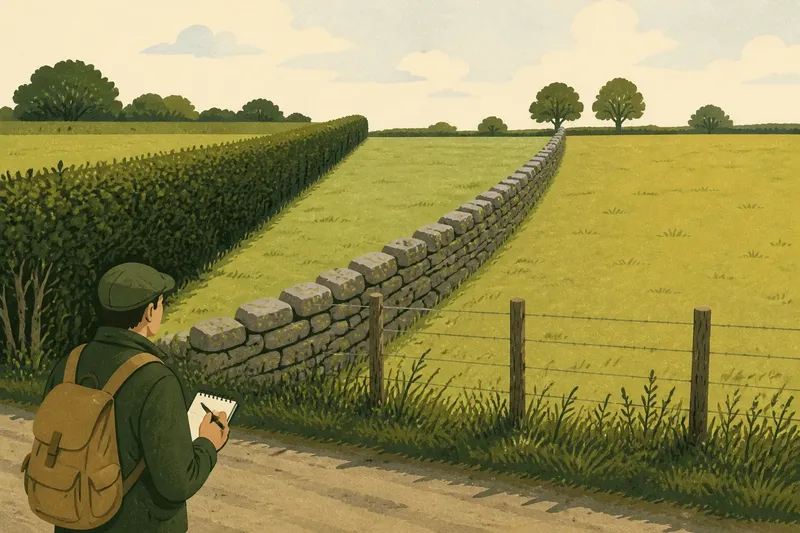
The common mistake in reading a field edge is to treat every boundary as a line on a map: a hedge, wall or fence may follow the same route, but each makes a different kind of landscape. A hedge, wall or fence reveals its form through height, texture, gaps and relation to the ground. Notice those clues before deciding what kind of pattern you are looking at.
Start with the visible line
Begin where a field boundary is easy to see from a public path, lane or viewpoint. Follow its course with your eyes rather than walking onto private land, and note whether it appears as a solid mass, a built strip, or a thin line held upright by posts.
A hedge is a band of woody growth, often with leaves, bare twigs and a rough upper outline. A wall is a built mass whose stones or other materials create a distinct face and crest. A fence is a barrier assembled from posts and rails, wire, or other manufactured components; open space between its parts is often visible.
Do not classify an edge from one feature alone. A hedge can conceal a fence, a wall can carry wire, and a line of shrubs beside a wall can make the boundary seem thicker than either structure by itself.
Read the hedge’s depth
Hedges occupy space, not just a line. Look for differences between the outer face and the top: a broad, uneven crown suggests branching growth, while a sharply trimmed face may make the hedge look more like a green screen. The ground beneath may be partly hidden by leaves, stems or a shallow bank.
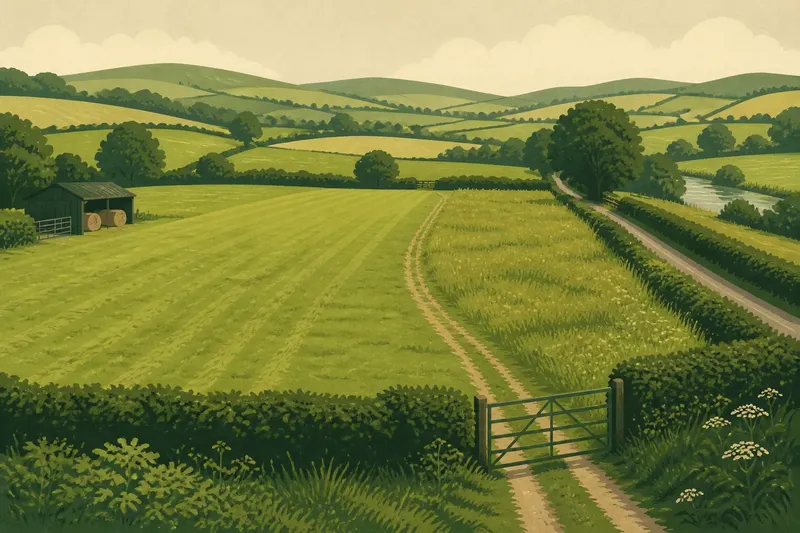
Its depth changes the apparent shape of a field. A thick hedge can soften corners and obscure the next field; a narrow, closely cut hedge tends to leave the field’s outline more legible. Gaps for a gate or track interrupt the green mass and can draw the eye toward a route through the land.
At different times of year, leaves alter how much of the hedge’s framework can be seen. In a leafy season, read its outer contour; when foliage is sparse, look for branching, embedded posts or a second boundary just behind it.
Read the wall’s course
A wall gives a field edge a firmer visual line. Its height, thickness and visible stonework may change along its length, especially where the ground rises or falls. Watch how the top of the wall relates to the horizon: a level crest across uneven ground can make a slope easier to read.
Stone color and texture can help distinguish the wall from surrounding vegetation, while moss or plants growing on it can blur the boundary. A wall that turns sharply may emphasize a corner; one that follows a gradual curve creates a softer enclosure without losing its built character.
Look for interruptions such as a gate opening or a lower section, but do not assume that a gap marks an abandoned boundary. A visible opening may simply be a route between fields, and the wall can continue beyond it.
Read the fence’s intervals
Fences tend to announce themselves through repetition. Posts create a sequence of upright marks, and rails or wire link them into a long, relatively narrow barrier. The repeated spacing can make a field edge look more regular than a hedge or irregular stone wall.
That regularity can also make the land beyond seem more exposed. A wire fence offers little visual screening, so a viewer may read neighboring fields as one broad sweep divided by a fine line. Rails create a stronger horizontal band, while taller posts can make the boundary stand out against open ground.
Check whether the fence follows a straight course or bends around a feature. A straight run may sharpen the geometry of a field; a curve can reveal an obstacle, a change in use, or a line adjusted to the shape of the ground. The fence itself does not explain why the route was chosen.
Compare the field pattern
Once you have identified the form, consider what it does to the overall view. Hedges often divide the scene into enclosed compartments because their foliage blocks sight. Walls mark divisions more distinctly than they screen views, and fences can leave long sightlines open while still making ownership or use appear divided.
These are visual effects, not fixed rules. A tall, overgrown hedge may hide more than a low stone wall, and a close-set fence can feel more substantial than a broken wall. Compare the boundaries in the same view and ask which one hides the land, which one outlines it, and which one leaves the view most continuous.
Imagine you are looking across two neighboring fields from a public lane: one has a dense hedge, the next a low stone wall, and a third a post-and-wire fence. The hedge would likely conceal parts of the field behind it, the wall would mark a strong edge while leaving more of the view open, and the fence would divide the ground with the least visual mass. Those expected differences make the pattern easier to describe without guessing at the landowner’s purpose.
Questions about field edges?
How can I tell a hedge from shrubs?
Look for a continuous boundary-shaped band with a distinct face or crown, rather than isolated bushes scattered through a field. A line of shrubs can function visually like a hedge, but its gaps and uneven spacing may make the edge less continuous.
Can a fence be hidden inside a hedge?
Yes. Posts, rails or wire may be visible through openings or where growth is sparse, while dense foliage can conceal them elsewhere. Describe the visible layers rather than forcing the boundary into a single category.
What makes a wall look different from a bank?
A wall usually presents a built face and a recognizable top, while a bank reads as raised earth with a softer, sloping profile. Vegetation can cover either form, so check for exposed stone or a change in ground level along the line.
Why do field boundaries change direction?
A boundary may bend around uneven ground, an existing feature, or an access point, but its shape alone does not reveal the reason. Describe the turn and its relation to nearby slopes, gates or tracks before proposing an explanation.
Make a short field note
For a useful record, choose one boundary and capture its appearance in a few precise observations. A small notebook or a simple sketch can preserve details that a general label such as “hedged field” would miss.
- Record whether the edge is mainly living growth, built material or a post-and-rail or wire structure.
- Note whether it is continuous, interrupted, layered or partly hidden.
- Describe its course as straight, curved, sharply angled or following a slope.
- Mark what the boundary hides and what remains visible beyond it.
- Include nearby features such as a gate, track, ditch or change in ground level.
Keep observation separate from inference: “stone wall with a gap beside a track” is more reliable than assigning a purpose you cannot see. If you compare the same edge again in another season, note what changed in visibility and what remained constant in its route.
Reading hedge, wall or fence field edges becomes easier when you pay attention to the space each boundary occupies and the view it permits. On your next walk, choose one junction where two boundary forms meet; their contrast can make the surrounding field pattern clearer than either edge alone.